
Active Bystander Intervention
Why Ending Gender-Based Violence Must Be in the Hands of Our Communities
Dominant responses to gender-based violence (GBV) often focus on punishment calling for harsher laws, longer sentences, and stricter policing. This carceral approach assumes that justice is achieved through incarceration. But this model centers the state and perpetrators, not survivors. It reinforces systems of surveillance and punishment that have historically harmed the very communities most vulnerable to violence.
The focus on individual perpetrators obscures the structural roots of violence — patriarchy, casteism, poverty, and heteronormativity and diverts attention from the social conditions that allow such harm to persist. Restorative and transformative justice ask a deeper question: What conditions allowed this harm to happen, and how can we change them? This invites us to imagine justice not as the state’s responsibility alone, but as a collective, community-based practice.
This is where active bystander intervention becomes a powerful feminist and restorative tool. Active bystander action is not just about reacting in a moment of crisis, it’s about taking collective responsibility for the environments we live and work in. It empowers individuals to recognise, interrupt, and challenge everyday forms of harassment or violence before they escalate. Instead of outsourcing justice to the state, active bystander action shifts the focus from punishment after harm to prevention before harm.
The focus is on creating spaces for dialogue and reflection, where people can examine how norms, silences, and complicity sustain gendered violence. Over time, this fosters community healing, a justice rooted not in fear or punishment, but in care and responsibility.
We are enabling community-centered care. Be an Active Bystander.
Our Active Bystander Journey:
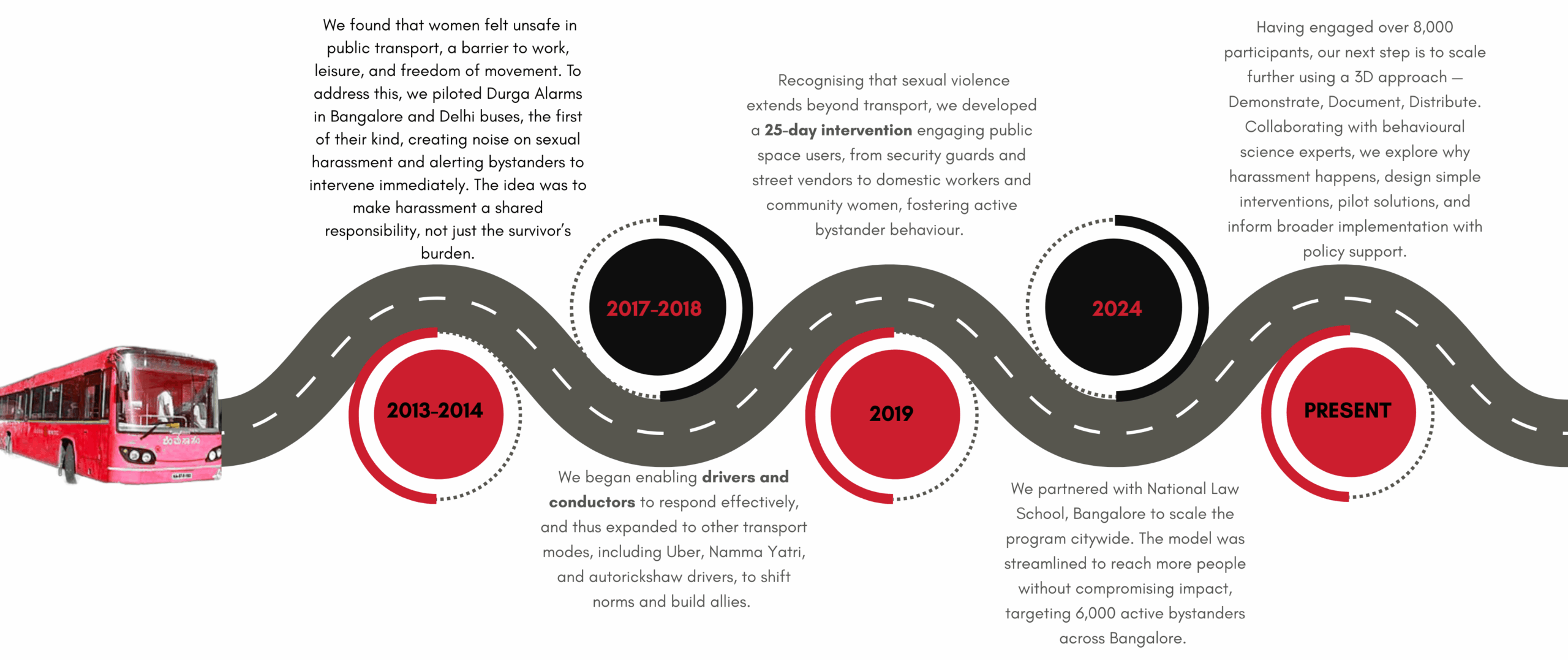
In 2013-2014, we found that women felt unsafe in public transport, a barrier to work, leisure, and freedom of movement. To address this, we piloted Durga Alarms in Bangalore and Delhi buses, the first of their kind, creating noise on sexual harassment and alerting bystanders to intervene immediately. The idea was to make harassment a shared responsibility, not just the survivor’s burden.
Next, we trained drivers and conductors to respond effectively, and expanded to other transport modes, including Uber, Namma Yatri, and autorickshaw drivers, to shift norms and build allies.
In 2019, recognising that sexual violence extends beyond transport, we developed a 25-day intervention engaging public space users, from security guards and street vendors to domestic workers and community women, fostering active bystander behaviour.
In 2024, we partnered with National Law School Bangalore to scale the program citywide. The model was streamlined to reach more people without compromising impact, targeting 6,000 active bystanders across Bangalore.
At present, having engaged over 8,000 participants, our next step is to scale further using a 3D approach — Demonstrate, Document, Distribute. Collaborating with behavioural science experts, we explore why harassment happens, design simple interventions, pilot solutions, and inform broader implementation with policy support.